Blind Angry Unhappiness
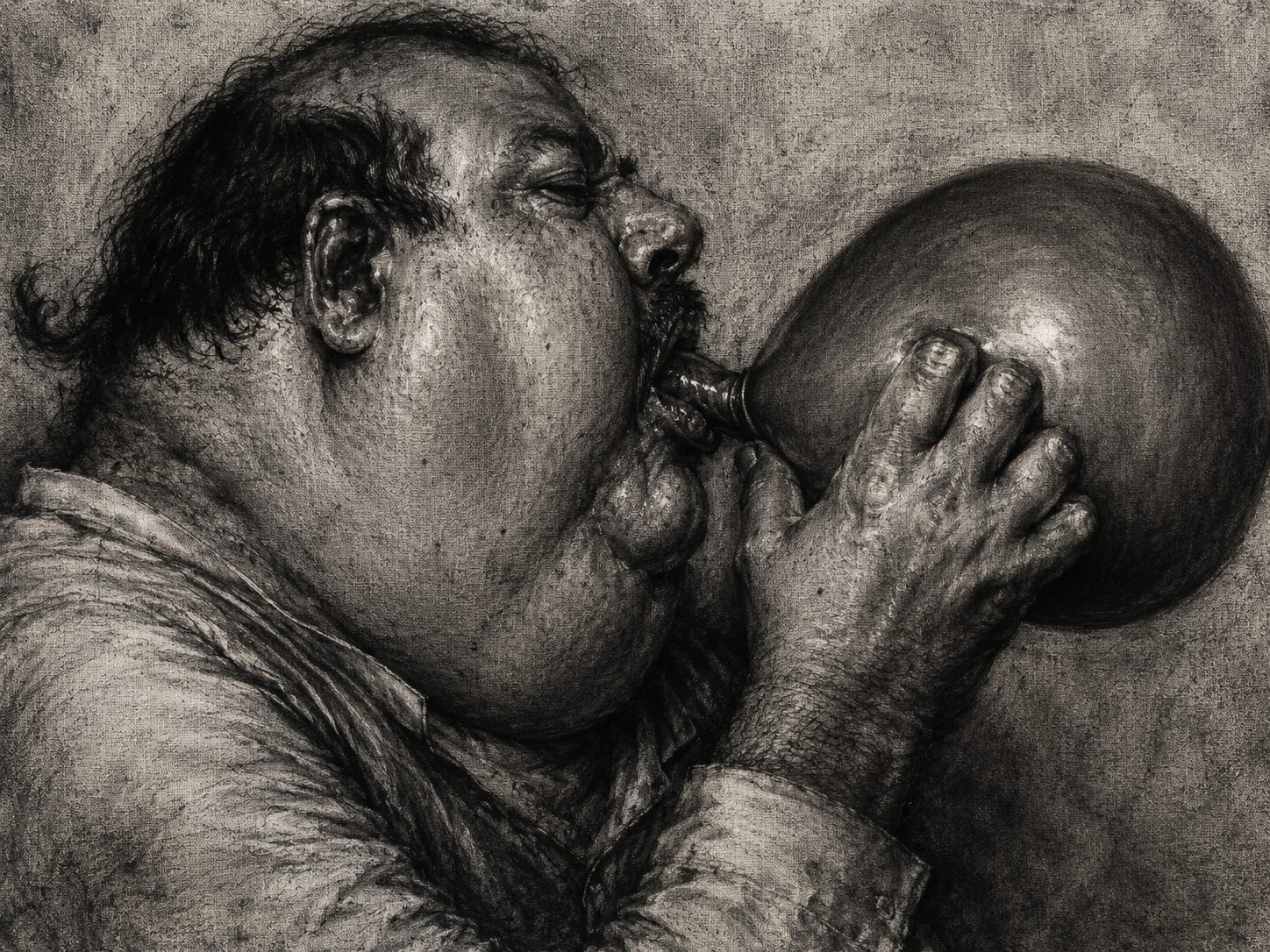
The sweat first gathers in the most undignified places, because the body, after fifty, becomes a landlord with opinions. It leaks. It complains. It sends damp notices from under the chest, behind the neck, inside the waistband, and other regions where no self-respecting philosopher should be receiving correspondence.
June in Calcutta is not weather.
It is a lawsuit filed by the atmosphere against the human spirit.
The fan above me turns with the tired righteousness of a government clerk who has stamped one thousand rejected pension applications and will stamp one thousand more before lunch. It does not cool the room. Let us not spread rumors. It merely moves the hot air from one side of the room to another, like a municipal department transferring a broken chair between offices and calling it progress.
And I sit there, a fifty-one-year-old Bengali man in a small flat on the edge of the city, sweating through old clothes, wondering which villain has done the most damage.
Age?
Heat?
Bipolar irritability?
Loneliness?
Money?
The collapsing comedy of opportunity?
Or that sly old thief called hope, who used to visit occasionally with cheap perfume and false promises but now seems to have changed her address without telling me?
Life, at this age, becomes a police lineup where every suspect looks guilty. Age stands first, in a faded vest, scratching his belly. Male menopause stands beside him, though strictly speaking men do not get the neat biological curtain-drop women get. No official ceremony. No garland. No brass band. Just a slow leaking of force, like an old ceiling fan losing speed year by year until one day it rotates mainly for sentimental reasons.
Then comes irritability.
Not ordinary irritation. Ordinary irritation is when the milk boils over or the neighbor drills a wall at 8:15 in the morning because apparently human civilization has not suffered enough. Bipolar irritability is different. It is irritation with a committee behind it. It arrives carrying files. It has evidence. It can make a spoon falling from the table feel like a personal insult issued by the universe.
Then loneliness enters, not dramatically, not in black robes, but like a lizard behind the calendar. You do not notice it all the time. Then one afternoon, when the light looks tired and the tea has gone cold, there it is.
Watching.
Earlier, I could at least imagine a fake future.
Not happiness exactly. Let us not behave like fools in a children’s book where the prince arrives on a white horse, or worse, a recruiter arrives on LinkedIn with an “exciting opportunity” that pays enough to rent a decent flat without consulting astrology. But I could imagine something. A slightly better room. A little more work. Cleaner water. A morning where the tea tasted like tea and not like boiled resignation. A woman who did not look at me and immediately remember an urgent family function in another district.
Small things.
Human things.
A future with one window open.
That is what has frightened me lately. Not that I am unhappy. Unhappiness is an old tenant. It knows where the cups are kept. What frightens me is that even the imagination seems to have cataract.
It used to project.
Now it squints.
This is why I call it blind angry unhappiness.
Sadness has eyes. Sadness points. It says, there, that photograph, that lost friend, that ruined chance, that dog dead by the roadside, that thing you could not save. Sadness at least has an address. It may be painful, but it can read a map.
Blind unhappiness cannot.
It stumbles around the room like a drunk uncle during a power cut, knocking over buckets, abusing furniture, blaming the country, blaming the body, blaming the past, blaming the present, and finally sitting in a corner breathing through its mouth like a demon with sinus trouble.
And anger, naturally, is the last working appliance.
Love went early.
Ambition rusted.
Pleasure retired and now sits in a cane chair refusing to discuss current affairs.
But anger still works. Anger hums. Anger makes noise. Anger is the old refrigerator in the corner with a loose door, a cracked tray, and a sound like a bus reversing into a tin gate. It eats current. It leaks dignity. But somehow, somehow, it keeps half a lemon alive.
So the mind uses it.
Why not?
The brain is not a saint. It is not even a very good electrician. It is a local repairman with a screwdriver in his pocket and suspicion in his eyes. If one wire sparks, it says, good enough. If one mood burns, it cooks on that flame. This is not wisdom. This is survival by jugaad.
The science people, when they are not turning human misery into neat diagrams, will explain it cleanly. Heat increases irritability. Poor sleep worsens emotional control. Loneliness sharpens stress. Age changes hormones. Bipolar disorder can turn ordinary annoyance into a knife with a handle. All true. Useful, even. Put it on a slide. Add a soft blue gradient. The brain overheats, the stress system drums on the table, dopamine pawns the family brassware, and serotonin has gone to Puri with relatives and switched off the phone.
But science, though necessary, does not describe the insult.
It is one thing to say the nervous system is activated.
It is another thing to sit in a rented flat in the shanty boondocks of Calcutta, sweating through old underwear, eating rice from a cooker, watching afternoon light crawl across the floor like a tired lizard, and realizing that the only reason you are socially safe is that you have removed yourself from society like a defective pressure cooker taken off the stove.
People say, “He is quiet.”
No.
He is contained.
There is a difference. A quiet man has peace. A contained man has bolts. A quiet man drinks tea. A contained man drinks tea because his hands need an assignment that is not damage, collapse, or twenty-seven messages typed on WhatsApp, deleted, retyped, deleted again, and finally replaced by one folded-hands emoji because language has become too risky.
That little yellow face is not communication.
It is a ceasefire.
Inside one “ok” there may be a whole district burning. Inside one thumbs-up there may be a man standing waist-deep in emotional floodwater, smiling politely at the rescue boat as it passes the wrong way.
This is what people misunderstand about loneliness. They think loneliness means absence of people, as if people are vitamins and one can correct the deficiency by swallowing three acquaintances after lunch.
But people are not automatically medicine.
Often people are infection.
People bring noise, judgment, advice, comparison, small fraud, big fraud, family politics, money talk, health tips, spiritual shortcuts, investment wisdom, and that magnificent Indian habit of diagnosing your entire life after looking at your face for eleven seconds.
“Go out a little.”
Excellent idea. I had not heard of outside. Apparently there is an outside, with buses, dust, heat, dogs, hawkers, potholes, honking, men spitting red philosophy into the road, and one scooter coming from the wrong direction with the confidence of a mythological weapon. Let me step into that public cauldron immediately so that my age, anxiety, irritability, bad sleep, bank balance, loneliness, and half-dead libido can all hold hands and perform a cultural program.
No.
I stay inside not because inside is good.
Inside is merely less explosive.
A flat can be a prison, yes. But it can also be a blast chamber. The walls are ugly. The corners collect dust. The bathroom smells faintly of old water and chemical defeat. The kitchen is a small republic of one pan, one cooker, one cup, and one spoon that has witnessed more philosophical collapse than most university departments. But the room contains the shrapnel. If I am bitter here, only my own wall is stained. If I am angry here, no stranger on the road has to receive the flying brick of my accumulated resentment.
There is a strange decency in becoming your own quarantine.
Not noble decency.
Let us not polish the sewage pipe and call it a temple bell.
It is more like waste management. The city does not purify everything. Much of the time it merely routes the ugliness somewhere less visible.
I have routed myself into myself.
Meanwhile, life outside continues with its usual confidence. Someone is selling mangoes as if mangoes can fix civilization. Someone is arguing over two rupees with the moral force of a Supreme Court petition. Somewhere a young man on a motorbike is accelerating toward his own stupidity. Somewhere an office is holding a meeting about transformation while the printer refuses to print. Somewhere an artificial intelligence model is writing a poem about empathy while a human being in a damp room is trying to decide whether bathing today is worth the negotiation with his own body.
This is the modern world. Satellites above, blocked drains below. Cloud computing in the advertisement, sewage smell in the tap. A nation can talk about the future all day, but the present still arrives with sweat under the shirt and a power cut at the wrong hour.
And what frightens me is not the suffering alone. Suffering is old. It sits down without invitation.
What frightens me is the loss of imaginary ventilation.
Earlier there was a small window in the mind. Through it I could throw a future. A fantasy. A possible version. Nothing grand. I was not imagining Switzerland, violins, and a Nobel Prize. I was imagining paid invoices. Decent sleep. A little less dread. A cup of tea that did not taste like evidence against me.
Now the window feels painted shut.
I look ahead and see not tragedy, because tragedy has shape, but repetition. Heat. Rent. Work uncertainty. Illness. Ageing. Mother’s needs. Tooth pain. Bank balance. Spoiled sleep. Old memories rising like gas from a drain. Me, the same muttering creature, slightly more swollen, slightly less employable, moving closer to that comic geological layer where men become furniture.
Hope, I think, dies less like a building collapse and more like mobile signal inside a lift.
Three bars.
One bar.
No bar.
Then you keep staring at the screen anyway, because what else will you do? You press refresh with a finger sticky from mango, sweat, and defeat, waiting for a tower that has no interest in your case.
Still, I have not exploded.
This is also irritating.
The body has vulgar loyalties. It wants tea. It wants rice. It wants air. It wants the fan. It wants to urinate. It wants sleep, even when sleep behaves like a government office and refuses to open the counter. The mind may be drafting a long complaint to existence, but the bladder says, get up, philosopher, I am full.
This is how survival happens in degraded conditions.
Not through inspiration.
Through urination.
A man may have no hope, no plan, no romance, no clean heroic arc, but biology will still grab him by the collar and send him to the bathroom. There is humility in this. Also comedy. Mostly inconvenience.
Perhaps a person can remain unhappy for a very long time. Longer than seems decent. Longer than literature permits. Longer than friends can tolerate. Longer than therapists can package. Longer than the self can narrate without becoming bored of its own suffering.
Unhappiness first becomes climate.
Then furniture.
Then accent.
Then smell.
Then posture.
You no longer say, I am unhappy. You say, where is my towel?
But blind angry unhappiness is dangerous because it removes the painted scenery behind pain. No future balcony. No fake palace. No cinematic turnaround. Just the room, the fan, the phone, the heat, the tea, the body, and the old internal dog snarling at nothing.
And yet I remain here.
Contained.
Sweating.
Unredeemed.
Not a prince. Not a hero. Not a cautionary tale with a clean moral. Just a middle-aged Bengali man in a small Calcutta flat, pressing one emoji into WhatsApp like a paper boat lowered into a monsoon drain, pretending for two seconds that it is communication.
Then the fan clicks.
The tea cools.
The street dog barks at some private enemy.
My underwear sticks to me like a legal notice.
And somewhere inside this overheated little room, one stubborn bitter organ continues beating out of spite, habit, and possibly gas.